Historic House of the Month: October 2026
Searching for the history of old buildings is exciting but can be challenging. Often, it can take a community sharing bits of information that may solve the puzzle.
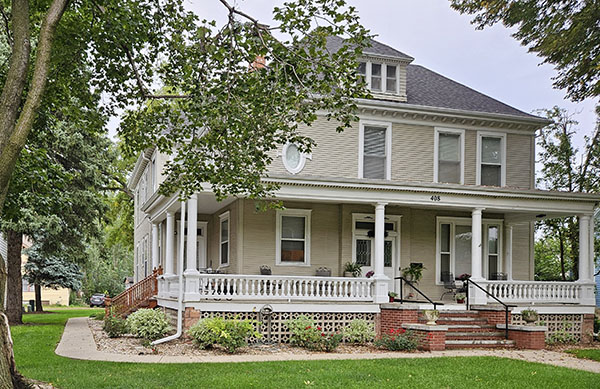
We are not sure of the date of origin of the October Historic House of the Month: 408 E. Main. It is listed as being built in 1900. Claude Garelik, current owner, shared with us that some city records listed buildings built just before the turn of the century as originating in 1900 but may in fact have been built even as much as 15 years prior. Vermillion researcher, Evelyn Schlenker found a newspaper reference to the house as far back as 1883.
This would explain how it could be true that Martin J. Lewis (b. 1843) previously lived in this house even though he died in 1896. Lewis was the brother of Anna Thompson (1849-1930) and Adele Inman (1848-1935) who lived across the street in what is now the "Inman House," the current official residence of the president of USD and the "Thompson House," or the "Pink House" which has been replaced by Founders Park. These houses were located on Main Street in 1882. Myron D. Thompson and Martin J. Lewis were not only friends and brothers-in-law but were Vermillion business partners. Elon C. Barton, who worked for the Thompson Lumber Company from 1897-1939 was also a resident of the house. And it served as the home of the Chi Omega sorority from 1937-1954. In the intervening years, there were a number of owners before Claude and Jean Garelik purchased it in 1995.
According to a description by Mary Troutman Gates in the 2009 National Register of Historic Places (NR) nomination, it is a two-story Colonial Revival style house. Most notable is the wide, front façade with a wrap-around porch on the front and west. Doric columns above paneled bases and the double front door with transom and leaded glass contribute to the grand elegance. Decorative features include dentils and a large oval window with keystones on the second floor of the front façade. The house has an asphalt hipped roof and attic dormers, also with hipped roofs. The exterior walls of the house are clad in horizontal wood siding, and the foundation of the building is constructed of brick and cut stone. The interior of the house retains the original oak moldings, paneling, grand staircase and two pocket doors. A contributing garage, c. 1915, is located at the back of the property. Its horizontal wood siding and asphalt hipped roof match the look of the house.
Few changes have been made to the exterior of the house. At some point, the railing was removed from the porch roof, across the front façade. The Gareliks repaired/rebuilt many aspects of the front and back porches including new stair railings, extended the garage, landscaped and made indoor renovations. They also plastered the walls in many rooms.
The house is listed on the National Register of Historic Places (NR) as part of the University Historic District, formerly Vermillion Historic District, which was recognized in 1975, revised in 2009 and renamed in 2018. For more information about 408 E Main and Vermillion's historic districts, please see VHPC | Historic Properties: Individual.
Each month, the commission is highlighting a house in Vermillion that is classified as a contributing property in the National Park Service's National Register of Historic Places (NR). Houses listed in the NR have maintained the historical integrity of their architectural and/or historical significance and are at least fifty years old. The house will be featured on the commission's website at VermillionHPC.org and on its facebook page, @Vermillion Historic Preservation Commission. The owner receives a certificate and a sign will be placed in the front yard of the property for the month.
The Vermillion Historic Preservation Commission is a volunteer commission whose mission is to protect, preserve, and restore Vermillion's historic and cultural assets through public education, workshops, and outreach to the community. VHPC commissioners and city staff contribute match for annual grants from the National Park Service, Department of the Interior through the South Dakota State Historic Preservation Office.
Photo courtesy of Susan Keith Gray
Historic House of the Month: September 2026
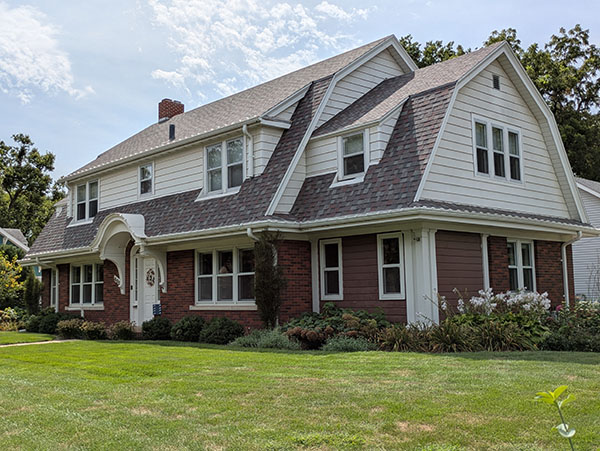
The September Historic House of the Month is another Chaney house but this time, the owner/builder was Morris J. Chaney (1858-1941), the patriarch of the Chaneys of Vermillion. Born in Illinois, he bought a farm in Newell, Iowa in 1880 but moved to Wakonda, South Dakota in 1893. He and his wife, Helen McFarline Chaney (1856-1922) had three children: Florence (1892-1922), Dorothy L (1895-1988), and Morris A (1898-1963).
Morris J. was president of the Bank of Wakonda and also Citizens Bank and Trust in Vermillion (1914). He served in the South Dakota legislature, becoming Speaker of the House from 1907-1909. Around 1910, he built 122 N. Yale but around 1928, he built the house at 405 S. University. Now a widower, he lived there with his daughter Dorothy and her husband Ralph Collins, and their son Gerald M. "Jeb" (1923-2006); Morris J.'s yet unmarried son, Morris A.; and his grandson, Bayard H. Waterbury, Jr. (1919-1979), whose mother, Florence had died in 1922.
The house is a Dutch Colonial subtype of Colonial Revival. It is one of only a few brick homes in Vermillion up to that time. On the second story, wood siding alternates with the asphalt shingles of the shed dormers and sloping roof. The north and south symmetrical wings are setback and have their own smaller dormers. The house faces east with a wide facade covering two lots. The centered front door has a rounded porch "hood" held up with decorative brackets. The door is further amplified by sidelights and a transom overhead. There is a detached garage, accessed from the alley to the south, which is believed to date to the construction of the house and made from the same brick. An original concrete patio connects the garage and house in the rear.
The exterior maintains a high degree of historical integrity. Changes include the enclosed porch of the first floor north wing and vinyl windows, all of which have maintained the original openings. The enclosure has red siding, the color of the brick with window spacing mimicking that of the south wing. The garage has been converted to two bay doors from three. Landscaping now includes a surrounding hedge.
On the main floor, the spacious house has a living room, dining room, kitchen, breakfast nook, half bath, sunroom, and office (the enclosed north porch), two fireplaces, and a central grand staircase. The second level has four bedrooms, one with a sitting room and two full baths. Few changes have been made in the inside as well. The sunroom to the south has cedar paneling and tile added during the mid-century, as well as the enclosed north porch/office with similar paneling. The kitchen is brand new. With the removal of a partial wall, the breakfast nook has replaced what has been called a maid's quarters, complete with a separate back entrance. All HVAC and central air are modernized though the original radiators remain.
The house is currently owned by Linda Kogel and has been recently placed on the market. Previous owners after the Chaney's were Dr. Ed and Mrs. Evalin Moore, a local physician; Darrell and Norma Merrigan, owners of Ideal Billiards/Charcoal Lounge, and after the death of Darrell in a car accident in 1968, Norma Merrigan and Ted Jelke; and Martin Busch, an inductee in the South Dakota Hall of Fame as Executive Director and "father" of South Dakota Public Broadcasting, including reading books on air through his program, "The Bookshop."
405 S. University is on the National Register of Historic Places (NR) as a part of the Jolley Historic District. For more information about 405 S. University and Vermillion's historic districts, please see VHPC | Historic Properties: Individual.
Each month, the commission is highlighting a house in Vermillion that is classified as a contributing property in the National Park Service's National Register of Historic Places (NR). Houses listed in the NR have maintained the historical integrity of their architectural and/or historical significance and are at least fifty years old. The house will be featured on the commission's website at VermillionHPC.org and on its facebook page, @Vermillion Historic Preservation Commission. The owner receives a certificate and a sign will be placed in the front yard of the property for the month.
The Vermillion Historic Preservation Commission is a volunteer commission whose mission is to protect, preserve, and restore Vermillion's historic and cultural assets through public education, workshops, and outreach to the community. VHPC commissioners and city staff contribute match for annual grants from the National Park Service, Department of the Interior through the South Dakota State Historic Preservation Office.
Photo courtesy of Susan Keith Gray
Historic House of the Month: August 2026
In 2001, the Linden House (509 Linden Ave.) was listed in the National Register of Historic Places. The nomination was written by Lynda Schwan and the owner of the house was Karen Muenster. In keeping with Karen's years of work in historic preservation in Sioux Falls (Cathedral District) and later in Vermillion, she sought to recognize and protect the special design and beauty of this mid-century house. Karen died this past April. We designate this house as the August Historic House of the Month in tribute to her.
In 1950, Morris A. Chaney (1898-1963) hired the acclaimed architectural firm of Hugill, Blatherwick and Fritzel of Sioux Falls to build this house. Hugill and Blatherwick had designed many public buildings in South Dakota including the Ziebach, Lake, Hughes and Clark County courthouses. Fritzel joined the firm in 1946. Other designs in the 1950s included the original Lee Medical School Building at USD (replaced). Many of their designs have been placed in the National Register.
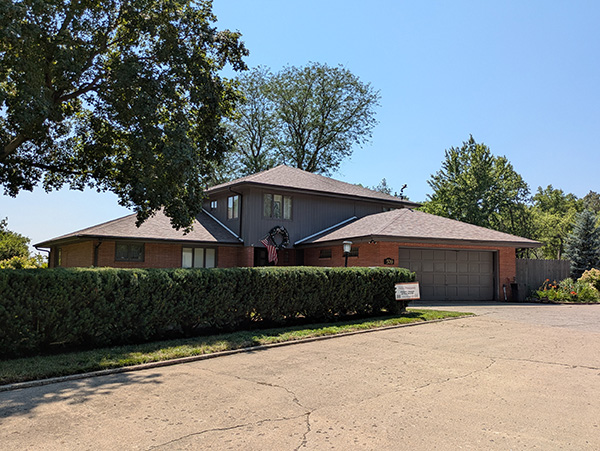
The style of the Linden House is Post Modernistic-a reaction to various styles such as International and Modern, from before WWII. The house borrows aspects of Craftsman and Prairie Style with overhanging eaves and a low profile. The roof of cedar shakes and a dark roman brick exterior are characteristics which blend into the landscape of the bluff. The central upper level has brown vertical wood siding.
Morris Chaney and his wife, Dorothy Bell Thompson Chaney (1906-1995) moved in with their six children. Cyndy, Mike and Robin currently reside in Vermillion, though not in the house. Cyndy describes it as one that was "welcoming to people of all ages." The family room was a hub of activity for the kids and their friends. As a teenager, she was also particularly impressed by the matching walls, curtains and bedspread in her room, designed by an interior designer from Omaha's Orchard and Wilhelm Department Store. She also recalls the pastel bathroom fixtures and the novel, poured-concrete foundation that garnered much attention. Succeeding owners included developer/businessman,Tom (Anna) Urup, a corporate owner, and, in 1999, Karen (Ted) Muenster.
The "back" of the house faces the bluff (to the south) with large picture windows, casement windows, glass patio doors, and a sunroom. The main, central section is two stories with a pyramidal roof. There are one-story wings on each end with pyramidal roofs sloping away from the center section and an attached garage on the north side next to the recessed main entrance. The first floor interior has large, open rooms. The second floor houses bedrooms with access to the balcony. The walls are built of reinforced concrete plaster. The floors, as well as the foundation, are poured concrete. Minimal alterations include an updated kitchen and an enlarged master suite. Karen also designed and had constructed a new "wing" on the west side of the home, which blends with the original design of the house, replacing the screened porch. For more information about 509 Linden, please see VHPC | Historic Properties: Individual.
Each month, the commission is highlighting a house in Vermillion that is classified as a contributing property in the National Park Service's National Register of Historic Places (NR). Houses listed in the NR have maintained the historical integrity of their architectural and/or historical significance and are at least fifty years old. The house will be featured on the commission's website at VermillionHPC.org and on its facebook page, @Vermillion Historic Preservation Commission. The owner receives a certificate and a sign will be placed in the front yard of the property for the month.
The Vermillion Historic Preservation Commission is a volunteer commission whose mission is to protect, preserve, and restore Vermillion's historic and cultural assets through public education, workshops, and outreach to the community. VHPC commissioners and city staff contribute match for annual grants from the National Park Service, Department of the Interior through the South Dakota State Historic Preservation Office.
Photo courtesy of Susan Keith Gray
Historic House of the Month: July 2026
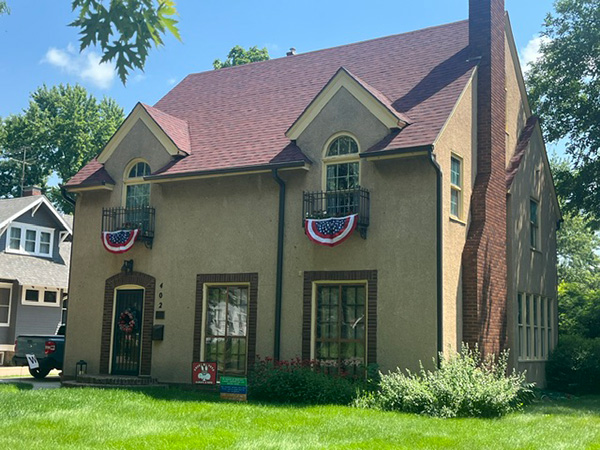
The Colton House at 402 S. University, is a (French) Tudor Revival style built by Andrew Meleen for Dr. Winfred Rufus Colton, the Dean of the College of Fine Arts at the University of South Dakota. It was listed on the National Register of Historic Places in 2007 as an individual property. The nomination was written by Mike Vogel. In addition, the house is a part of the Jolley Historic District which was listed in 2022.
Built in 1938, the house is thought to be the only example of Tudor Revival in Vermillion. Characteristics which are easily seen include the steep roof with side gables, multi-paned (often six-over-six) windows and the large chimney on the south end. The stucco cladding also represents a subtype of Tudor Revival. Other distinguishing features of this exterior are the long-pane vertical windows in the front, two gabled wall dormers, brick trim around the windows, the door, on the porch, and for flower boxes, Palladian windows in the upper levels, and iron faux balconies.
As an individual property, evidence was provided that the interior as well as the exterior had retained its historic integrity. The only alteration to the Colton House is a small kitchen addition in the back. (A 2-car garage in the back of the property is not contributing and is not part of the national register listing.) The remaining floor plan has not been altered. The interior boasts original mahogany doors, French doors, and a pocket door on the main floor, original brass hardware, built-in china cabinet and bookshelves, and a wooden staircase.
The owner at the time the house was listed on the national register was Sue Kraemer Christensen. The current owners are Susan and Larry Hudson. It is said that when the house was built, it became a popular place for receptions and visiting dignitaries due to Dr. Colton's prominence in Vermillion and in his profession. The violinist, orchestra conductor and administrator came to USD in 1908 and was Chairman/Dean from 1921-1951. It was during his tenure that the fine arts department became the College of Fine Arts in 1921. He also wrote the music to the USD alma mater which was premiered in 1922. Colton Recital Hall in the Warren M. Lee Center for the Fine Arts is named for him. For more information about 402 S. University, please see VHPC | Historic Properties: Individual.
Each month, the commission is highlighting a house in Vermillion that is classified as a contributing property in the National Park Service's National Register of Historic Places (NR). Houses listed in the NR have maintained the historical integrity of their architectural and/or historical significance and are at least fifty years old. The house will be featured on the commission's website at VermillionHPC.org and on its facebook page, @Vermillion Historic Preservation Commission. The owner receives a certificate and a sign will be placed in the front yard of the property for the month.
The Vermillion Historic Preservation Commission is a volunteer commission whose mission is to protect, preserve, and restore Vermillion's historic and cultural assets through public education, workshops, and outreach to the community. VHPC commissioners and city staff contribute match for annual grants from the National Park Service, Department of the Interior through the South Dakota State Historic Preservation Office.
Photo courtesy of Larry and Susan Hudson
Historic House of the Month: June 2026
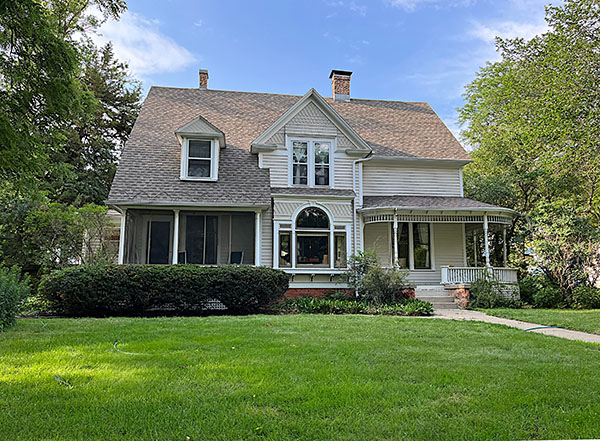
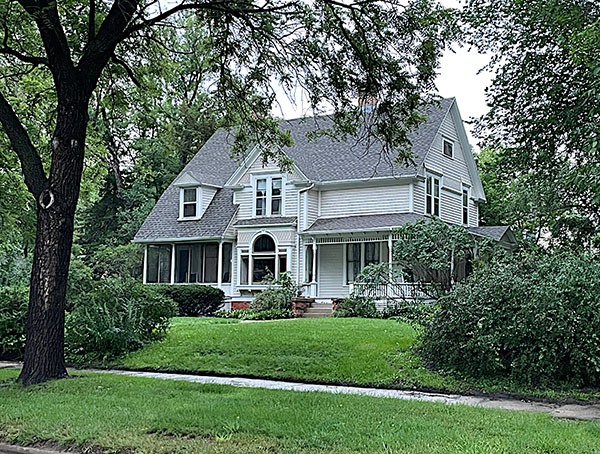
The Brookman House is a Queen Anne structure that has been lovingly cared for by members of the Brookman and Flanagin families since 1894. It presides over the corner of Dartmouth Street and Cottage Avenue and was listed on the National Register of Historic Places in 2023.
The house was built by Eric G. Matson (Dalesburg Lutheran Church, the West Side and East Side Schools, many houses) for S.E. and Anna Brookman. S.E. and his twin brother Edgar worked in milling and steam-power in the Vermillion area. S.E. had 4 accomplished sons, the oldest being Harold (Ruth), who was an engineer, architect and USD faculty member in engineering and in applied science. He was responsible for the steam tunnels built under the campus, designed Danforth Chapel and designed the first swimming pool in Prentis Park. Brookman Hall (1963 campus dormitory, demolished in 2023) was named for Harold. Ruth was prominent in city organizations including the Civic Council, the school board, and the Vermillion Development Company. They lived in the house from 1925-1972. Jon and Judy Flanagin purchased the house in 1973. Judy died in 2013 and Jon remained in the house until his death in 2023. Both taught at the University of South Dakota until their retirements in 2005. Jon was professor and chair of Sociology, Anthropology, and Social Work; Judy taught in speech pathology. Their sons, Craig and Andrew own the house and are prepared to sell it to an equally devoted owner (contact flanagin@ucsb.edu).
From the late Victorian period, the house is a well-preserved example of the Spindlework subtype of Queen Anne. This subtype is exemplified by such aspects as the turned posts of the wrap-around porch, the frieze spindles below the roof of the porch, scrolled brackets and decorative shingles. The narrow front of the house faces Cottage Avenue (404) and the gabled front door leads to its elegant entryway. The two and a half stories with their dormer and gable, a picture window, and screened and open porches dominate the southern expanse of the house and side yard which can be seen from Dartmouth Street. A garage west of the house, showing Craftsman elements, replaced an old barn in about 1915.
Careful modernization has retained the historic integrity. Original oak flooring and trim, plaster and lathe walls, stained glass windows, a pocket door, a fireplace, and a built-in china cabinet remain and grace the living rooms of the first floor. The second floor houses four bedrooms, an office, a storage closet and a full bathroom which was modernized with period features. On the main floor, the back porch was enclosed for more kitchen space. For more information about 404 Cottage Avenue, please see VHPC | Historic Properties: Individual.
Each month, the commission is highlighting a house in Vermillion that is classified as a contributing property in the National Park Service's National Register of Historic Places (NR). Houses listed in the NR have maintained the historical integrity of their architectural and/or historical significance and are at least fifty years old. The house will be featured on the commission's website at VermillionHPC.org and on its facebook page, @Vermillion Historic Preservation Commission. The owner receives a certificate and a sign will be placed in the front yard of the property for the month.
The Vermillion Historic Preservation Commission is a volunteer commission whose mission is to protect, preserve, and restore Vermillion's historic and cultural assets through public education, workshops, and outreach to the community. VHPC commissioners and city staff contribute match for annual grants from the National Park Service, Department of the Interior through the South Dakota State Historic Preservation Office.
Photos: Andrew Flanagin
Historic House of the Month: May 2026
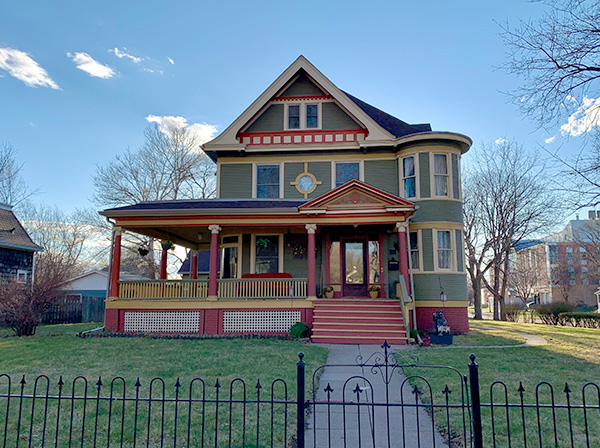
Many period features highlight the stately Queen Anne at 122 N. Yale which is the Vermillion Historic Preservation Commission's Historic House of the Month for May. Instantly notable features include the wrap-around porch, the two-story tower and north side bays, round accent windows, decorative dentils, Ionic columns, and the period carriage house on the west end of the property. Built in 1910 by Morris Chaney, it remains one of the iconic grand houses of Vermillion's first historic district. The Chaney's lived in the home for 4 years before it became a USD fraternity and sorority for many years, as seen in the USD Coyote yearbooks. This well-preserved house is listed in the National Register of Historic Places as a member of the University Historic District (formerly Vermillion Historic District) with a period of significance from 1875 to 1930.
This modernized Victorian is a 5-bedroom residence that offers all the character of a bygone era with top-to-bottom restoration (including electric, plumbing and HVAC) that preserved the home's historic integrity. The foyer boasts original wood features and a grand staircase. There are hardwood floors throughout and original beautifully restored woodwork on all three levels. Pocket doors, wood fireplace, and high ceilings with period-style wallpaper showcase the home's original beauty. The carriage house garage was built in 1999 to replicate the original carriage house that had been destroyed by fire. The current owner, Michelle Laughlin, purchased the home in 1996 and it is currently for sale, ready for a new owner to enjoy.
Each month, the commission is highlighting a house in Vermillion that is classified as a contributing property in the National Park Service's National Register of Historic Places (NR). Houses listed in the NR have maintained the historical integrity of their architectural and/or historical significance and are at least fifty years old. The house will be featured on the commission's website at VermillionHPC.org and on its facebook page, @Vermillion Historic Preservation Commission. The owner receives a certificate and a sign will be placed in the front yard of the property for the month.
The Vermillion Historic Preservation Commission is a volunteer commission whose mission is to protect, preserve, and restore Vermillion's historic and cultural assets through public education, workshops, and outreach to the community. VHPC commissioners and city staff contribute match for annual grants from the National Park Service, Department of the Interior through the South Dakota State Historic Preservation Office.
Photo: Michelle Laughlin
Historic House of the Month: April 2026
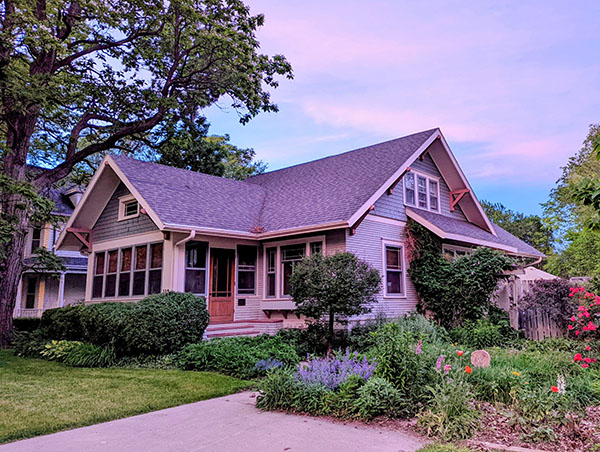
119 N. University Street is the Vermillion Historic Preservation Commission's Historic House of the Month for April. The house is in the University Historic District, just south of the University of South Dakota campus. This neighborhood was Vermillion's first historic district and was originally called Vermillion Historic District when listed in 1975. Most houses were constructed between 1875 and 1930, developing as the town and university grew, providing single family, duplex and boarding house accommodations for townspersons as well as many students, staff and faculty of the university.
The one and one-half story Craftsman bungalow at 119 N. University Street was built in 1921. The owner of the property at the time was Annie B. (Cleland) Nelson and husband Willie. In 1923, nurses Kathryn Cowan and Kathryn F. Troy bought the house and moved their St. Catherine's Hospital from 428 Cottage St. to this location. (See: Evelyn Schlenker, The Dakota Hospital Association and the Building and Maintenance of the Dakota Hospital in Vermillion, SD at cchpc.org.) Current owner Susan Keith Gray purchased the house in 1995. Gray is the current chair of the Vermillion Historic Preservation Commission and has served as chair of the University Historic District Neighborhood Association.
The side-gabled bungalow has original wood lap siding and wood shingles (on the gable fronts). Original windows are grouped in multiples and are one-over-one double-hung with prairie grid muntins in the upper sashes. The enclosed front porch has contemporary metal combination storms/screens. A 1978 garage sits at the back of the property. Cottage garden landscaping fills much of the yard. The interior remains in good repair with original oak moldings and flooring. The kitchen and bathrooms have been remodeled at least twice and the sleeping porch in the back is closed in. More information about 119 N. University Street and its district can be found in the nomination document at the National Register of Historic Places website, also accessible through the commission’s website.
Each month, the commission is highlighting a house in Vermillion that is classified as a contributing property in the National Park Service's National Register of Historic Places (NR). Houses listed in the NR have maintained the historical integrity of their architectural and/or historical significance and are at least fifty years old. The house will be featured on the commission's website at VermillionHPC.org and on its facebook page, @Vermillion Historic Preservation Commission. The owner receives a certificate and a sign will be placed in the front yard of the property for the month.
The Vermillion Historic Preservation Commission is a volunteer commission whose mission is to protect, preserve, and restore Vermillion's historic and cultural assets through public education, workshops, and outreach to the community. VHPC commissioners and city staff contribute match for annual grants from the National Park Service, Department of the Interior through the South Dakota State Historic Preservation Office.
Photo: Susan Keith Gray
Historic House of the Month: March 2026
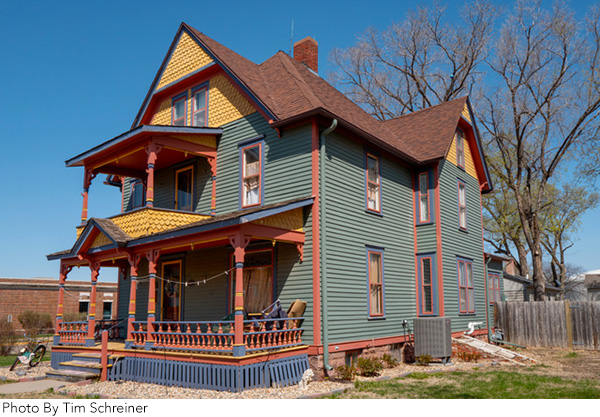
The Willey House at 104 Court Street was added to the National Register in 1982. At the time, it was owned as rental property by Judith and James Krueger. Judith Krueger is the author of a book on the Forest Ave. Historic District and wrote the nomination document submitted to the National Register for Willey House. The house is now in the Bluff Historic District which was formed in 2016.
W.E. Willey was influential in the city and state politics as the owner and editor of the Dakota Republican newspaper from 1883-1903. His house was built in 1895 by Andrew Pickett, who also built the Austin-Whittemore House. Stone mason, Hans Becklin built the granite foundation. Becklin also worked on the H.L.Dow-designed, First Baptist Church building.
Current owner Holly Straub purchased the Queen Anne house in 1999. By that time, it had been converted back to a single family structure. Straub had it painted in the current color scheme highlighting the porches, roof angles, and other external features. A detached garage with features designed to match the style and period of the house was constructed on the south side after 1999.
More information about 104 Court Street and its district can be found in the nomination document at the National Register of Historic Places website, also accessible through the commission's website.
Each month, the commission will highlight a house in Vermillion that is classified as a contributing property in the National Park Service's National Register of Historic Places (NR). Houses listed in the NR have maintained the historical integrity of their architectural and/or historical significance and are at least fifty years old. The house will be featured on the commission's website at VermillionHPC.org and on its facebook page, @Vermillion Historic Preservation Commission. The owner receives a certificate and a sign will be placed in the front yard of the property for the month.
The Vermillion Historic Preservation Commission is a volunteer commission whose mission is to protect, preserve, and restore Vermillion's historic and cultural assets through public education, workshops, and outreach to the community. VHPC commissioners and city staff contribute match for annual grants from the National Park Service, Department of the Interior through the South Dakota State Historic Preservation Office.
Historic House of the Month: February 2026
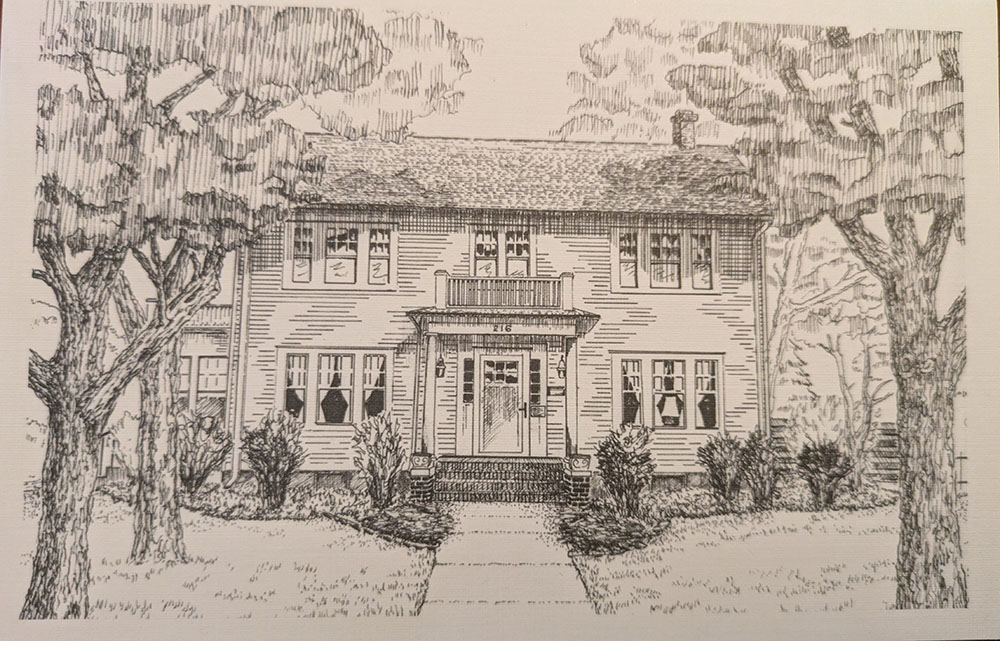
216 Forest Avenue is the second house in the Vermillion Historic Preservation Commission's (VHPC) Historic House of the Month project. It was built in 1923 by Peter Miller, a Vermillion Banker. It is located in the Forest Avenue Historic District. Forest Avenue began to develop in 1873 as a location that was scenic and provided accessibility to the town below the bluff via the adjacent ravine road (Dakota Street). After the flood in 1881, and the growth of the town above the bluff, the area developed much more rapidly. According to the Dakota Republican newspaper in 1886, due to its rare trees, the area attracted "a good class of citizens" who wished to be near the downtown and the university.
This two-story Colonial Revival maintains its symmetrical facade of a central entry porch with columns and an upper story balustrade. Three-sectioned, six-over-one windows in both stories, flank each side of the entry. The current house owner is Erin Beyers. Renovations only to the interior were made in the late 1990s.
More information about 216 Forest Avenue and its district can be found in the nomination document at the National Register of Historic Places website, also accessible through the commission's website and in The Forest Avenue Historic District: Vermillion South Dakota, 1873-1980 by Judith Gudger Krueger.
Each month, the commission will highlight a house in Vermillion that is classified as a contributing property in the National Park Service's National Register of Historic Places (NR). Houses listed in the NR have maintained the historical integrity of their architectural and/or historical significance and are at least fifty years old. The house will be featured on the commission's website at VermillionHPC.org and on its facebook page, @Vermillion Historic Preservation Commission. The owner receives a certificate and a sign will be placed in the front yard of the property for the month.
The Vermillion Historic Preservation Commission is a volunteer commission whose mission is to protect, preserve, and restore Vermillion's historic and cultural assets through public education, workshops, and outreach to the community. VHPC commissioners and city staff contribute match for annual grants from the National Park Service, Department of the Interior through the South Dakota State Historic Preservation Office.
Photo is Calligraphy by Don Levsen
Historic House of the Month: January 2026
This January, the Vermillion Historic Preservation Commission (VHPC) is launching its Historic House of the Month project. Each month, the commission will highlight a house in Vermillion that is classified as a contributing property in the National Park Service's National Register of Historic Places (NR). The house will be featured on the commission's website and on its facebook page, @Vermillion Historic Preservation Commission. The owner receives a certificate and a sign will be placed in the front yard of the property for the month.
Houses listed in the NR have maintained the historical integrity of their architectural and/or historical significance and are at least fifty years old. Houses may be listed individually or as part of a district. Vermillion has four residential historic districts-University, Forest Avenue, Bluff and Jolley, as well as several houses listed individually. Other local historic properties include the Downtown Historic District, the USD Historical Core District, and a number of individually listed properties.
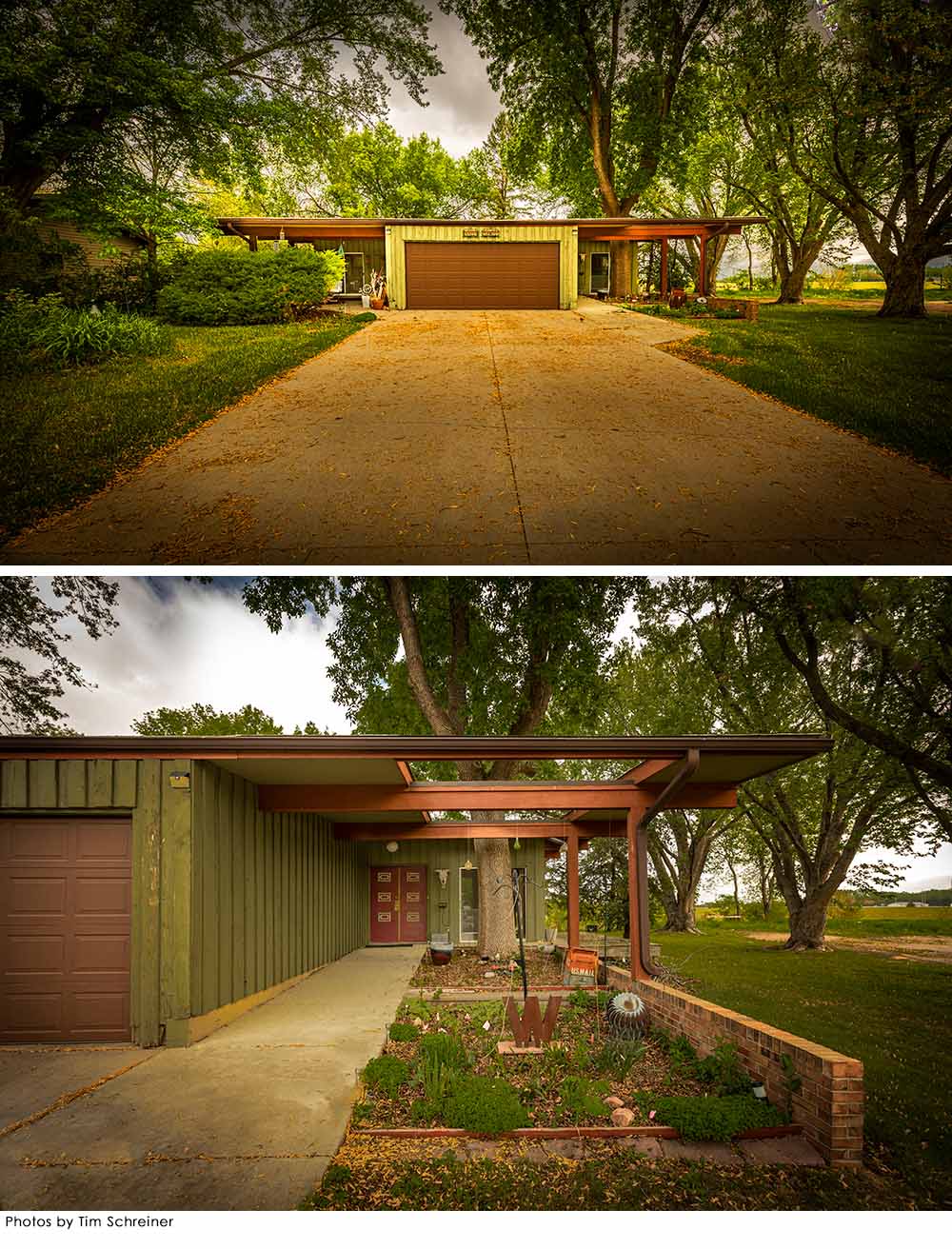
For the first house, the commissioners chose the Jacobson House at 1101 James Street. The owner is Jim Wilson. The Basil H. and Frances Jacobson House was designed by architect John Normile, who was the Building Editor of the Better Homes & Gardens magazine for more than 30 years. The plans for the home were purchased through the Better Homes & Gardens' house plans service, and the house was constructed in 1968 for the Jacobsons as first owners. It is an example of a Mid-Century Modern style of architecture referred to as the Contemporary style. It has been referred to locally as an "Atomic Ranch" style house.
The house maintains many of the characteristics of this style. This single-family, one-story house has a shallow roof with overhanging eaves. The roof beams extend into the patio and porch spaces in the front and are exposed in the internal vaulted ceiling over the open floor plan.
The style encourages a connection between the indoors and the outdoors. A notable landscape feature is an ash tree growing through the open porch roof. In an atrium in the main living area, plants grow under skylights, in a soil-filled pit. Sliding windows and doors connect to the natural setting outside. Natural materials are used throughout including the large brick fireplace and chimney.
Some changes appear to have been made to the original plan at the time of construction. Minimal changes, perhaps in the 1980s or 1990s, such as kitchen and bathroom flooring, and kitchen cabinets, used matching materials. More information about the Jacobson House can be found in the nomination document at the National Register of Historic Places website, also accessible through the commission's website.